

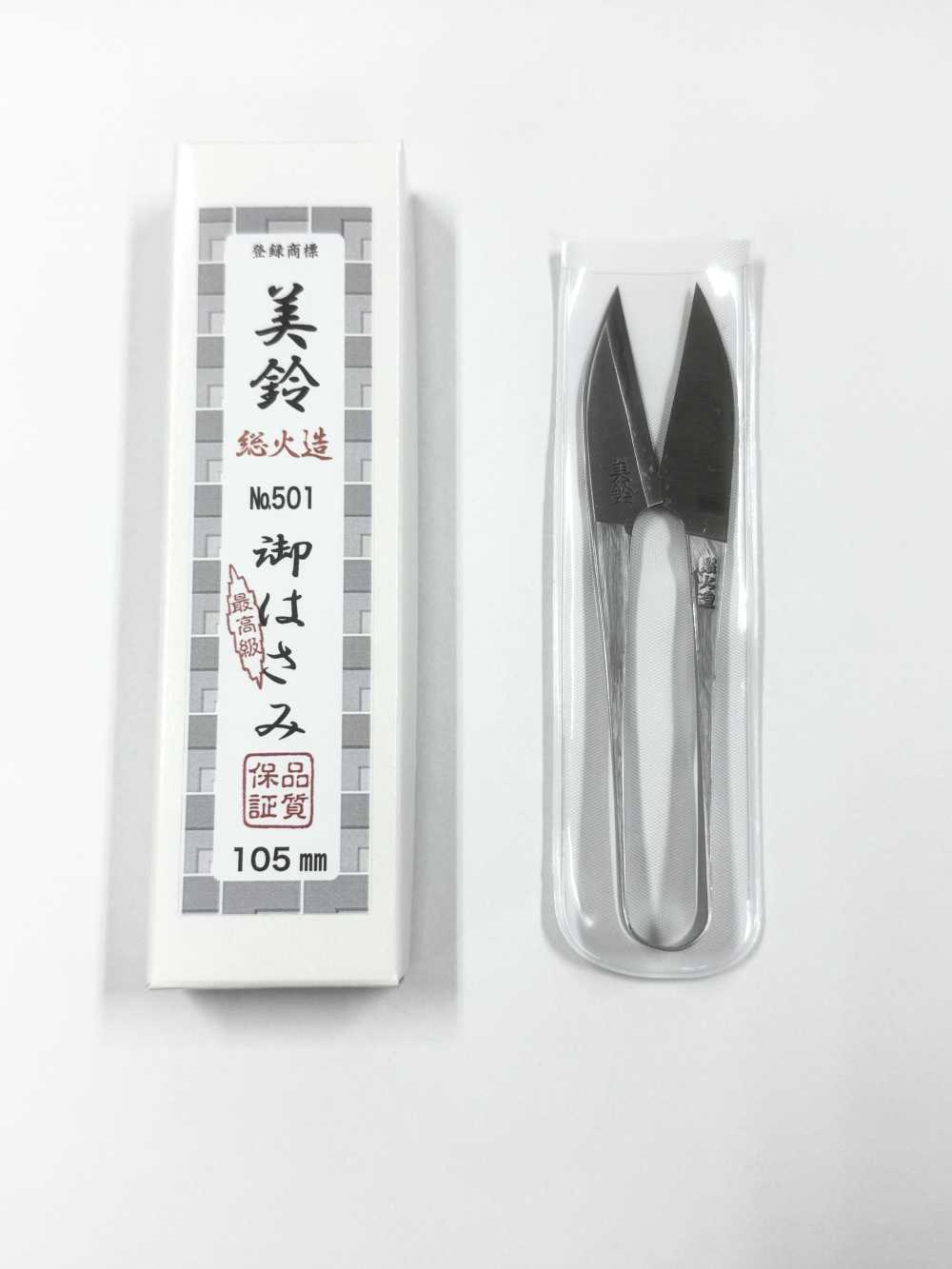
The fierce heat of summer is at last beginning to ease, and morning and evening now carry the faintest hint of autumn. We hope this finds you all keeping well.
This is Yu Yamamoto from the TAILORS WORLD editorial team. As always, thank you sincerely for your continued patronage of our materials. This time, I would like to change tack a little and take a moment to introduce, in some detail, a “tool” we are truly proud to recommend.
目次
What I would like to present is a nigiri-basami (a Japanese hand-held spring scissor) from Misuzu Hasami Co., Ltd., known by the name “Souhizukuri.” Into this small tool — indispensable for sewing and thread-cutting — is packed an astonishing amount of the very essence of Japanese craftsmanship!! Weaving in the history of scissors and the steps of a manufacturing method found nowhere else, let us explore its appeal together.
The Long Journey of the Nigiri-Basami (Wa-Basami)
First, let us unravel a little of the history of scissors themselves. Their origins are surprisingly ancient: the earliest scissors are said to have been used around the 10th century BC in ancient Greece, for shearing wool. Greek-type scissors later reached China around the 6th century, and it is thought that they were transmitted to Japan by way of China. There are even examples that have been excavated from ancient burial mounds (kofun) — quite astonishing, isn’t it!!
The U-shaped scissors we call nigiri-basami or “thread-cutting scissors” are, more precisely, known as wa-basami (Japanese scissors). In contrast to the “Western scissors” formed of two blades riveted together in an X shape, the wa-basami has a wonderfully simple and beautiful structure, in which the curved middle of the U acts as a spring. Until the Edo period, when people spoke of the scissors used in everyday life, it was generally this nigiri-basami they had in mind. Today their uses have narrowed to thread-cutting, candy craft, and the like — yet this tool, which can be handled as though it were an extension of one’s own fingertips, is still quietly loved on the front lines of Japanese and Western dressmaking alike.
“Souhizukuri” — Forged in Fire, Without a Mold
Now, here is where the heart of the matter begins. The greatest distinguishing feature of the Misuzu nigiri-basami we are introducing today is a manufacturing method called “Souhizukuri” (literally, “wholly fire-made”).
In fact, most nigiri-basami made in Japan today are produced using “composite steel” — material in which iron and hagane (high-carbon steel) have been bonded together in advance. This makes it possible to produce items efficiently and with consistent quality.
Souhizukuri, on the other hand, uses no such composite steel at all. The craftsman heats iron and steel to roughly 1,000°C, joins them by striking with a hammer, and at the very same time shapes the thickness and form — every bit of it by hand. To forge two different metals, iron and steel, into a single blade using nothing but the power of fire and hammer: this method, which carries a piece through in one continuous process from the joining of iron and steel to its final shaping, is precisely what is meant by Souhizukuri.
To be perfectly honest, this is an extremely labor-intensive method, and one that yields many failures. Judged by efficiency alone, it is by no means a profitable way to work. And yet, precisely because of this, the craftsman is able to bring his own hand to bear on every last detail — the strength of the spring, the feel of the grip, the balance of the blades. The uncluttered, sculptural beauty and the supple, keen cutting edge unique to Souhizukuri are, in the end, the fruit of this painstaking extra effort.
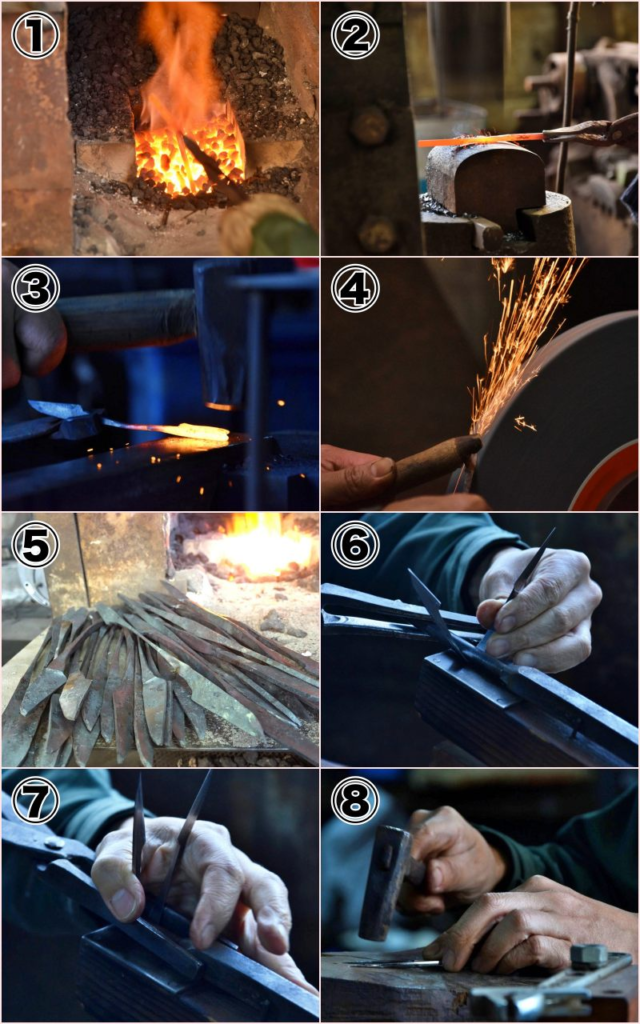
The Chosen Steel: Yasuki-Hagane White Paper No. 1
It is no exaggeration to say that a tool’s quality is decided by its material. For the blade of the Misuzu Souhizukuri nigiri-basami, a high-grade cutlery steel of great renown is used: “Yasuki-Hagane (Yasuki steel) White Paper No. 1.”
Yasuki-Hagane is a steel brand produced at the Yasugi Works of Hitachi Metals, inheriting the tradition of tatara ironmaking that long flourished in and around the city of Yasugi in Shimane Prefecture. Its very name derives from the fact that Yasugi was once the port from which the steel made in this region was shipped out. Among its grades, “White Paper” is a high-purity carbon steel in which alloying elements and other impurities have been kept to an absolute minimum. Because there is so little to hide behind, the skill of the smith shows itself directly in the finished blade — it is, in a sense, a steel that “allows no bluffing.” Put the other way around, it is a material that reveals its true worth only when forged by a craftsman of genuine skill. The surface is given a beautiful polished (migaki) finish. Take one in hand, and its dignified bearing may well make you straighten your own posture.
Our Recommended Piece: Misuzu Souhizukuri 105mm
Now, as a fine example in which the artistry of Souhizukuri lives and breathes, the piece we carry is this “Misuzu Souhizukuri 105mm.” Of all the nigiri-basami out there, this 105mm short-blade type is exactly the right size for fine, close handwork, beginning with thread-cutting.
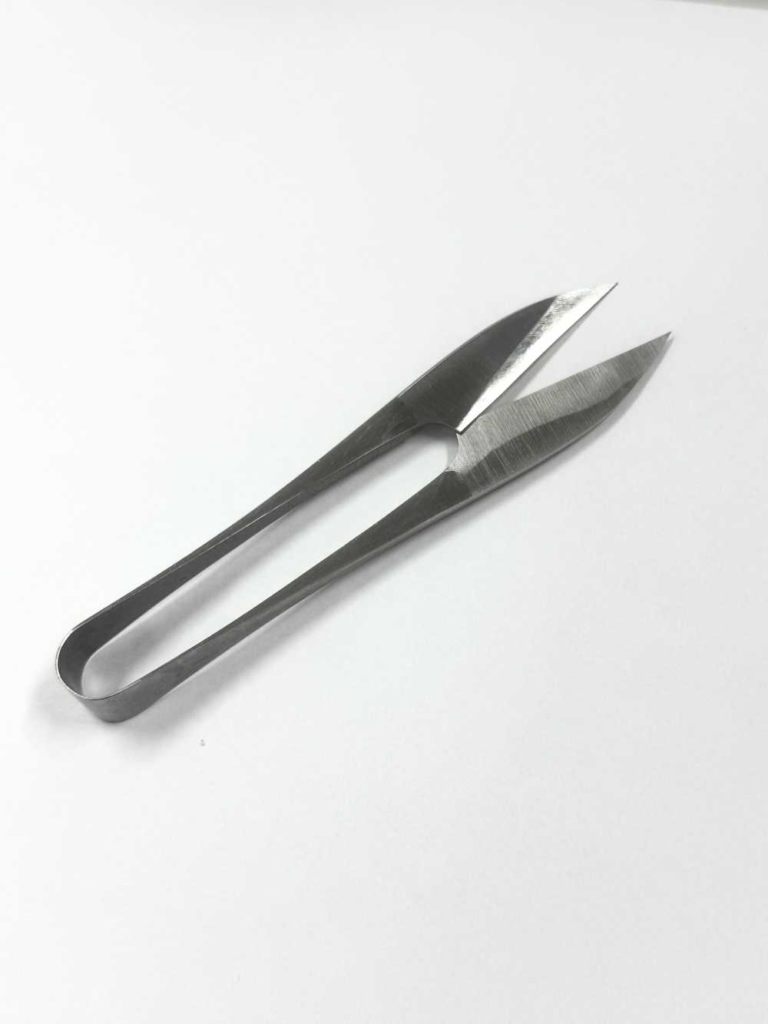
The blade, of course, uses the Yasuki-Hagane White Paper No. 1 introduced above, with a polished migaki finish on the surface. It is precisely because this pure, unblended steel is patiently forged by the Souhizukuri technique that it delivers that wonderfully satisfying cut — slicing cleanly through thread in an instant. The way the spring settles perfectly into the hand, and the exquisite balance you feel as you squeeze, are flavors that can only come from each piece being finished by a craftsman’s hand. And it is, of course, genuinely made in Japan. Simply tucking one into your sewing box is enough to make your daily handwork feel that much more pleasant.
One note: carbon steels such as White Paper, for all their excellent cutting performance, are a touch delicate when it comes to moisture. To keep yours in good condition for years to come, we recommend wiping off any moisture after use and, from time to time, applying a thin coat of camellia oil before storing it away. Give a tool your care, and it is sure to answer in kind.
In Closing
So, what did you think? This time, we introduced the Misuzu Hasami “Souhizukuri” nigiri-basami — and in particular the “Misuzu Souhizukuri 105mm” that we carry.
Within a single nigiri-basami are condensed the whole history of scissors stretching back to before the Common Era, the culture of the wa-basami as a tool uniquely Japanese, and the craftsman’s skill of forging steel with nothing but fire and hammer. In an age when making things in great numbers, uniformly and by machine, has become the norm, to nonetheless spare no effort and go on forging each and every piece by human hand — that very stance, we believe, is the true essence of the Japanese craftsmanship of which we are so proud on the world stage.
A tool is something that grows together with the one who wields it. It may be a slightly costly little piece, but as a partner you can rely on for a lifetime, we would be delighted if you would take one in hand and try that cutting edge for yourself. For orders and inquiries about the above, as well as any questions regarding accessories or sewing services, please do feel free to reach out to us. We look forward to hearing from you!!
For orders, inquiries, or questions regarding trimmings and sewing services, please feel free to contact us.

After 2 years of training at a major order-made suit store in Japan, I started my career in apparel materials and fabrics.
I’m especially good at suits and coats.